
Switzerland’s approach to embedding sustainability throughout the IIHF World Championship 2026 has earned it this year’s IIHF Sustainability Award, recognizing work designed to leave a positive legacy long after the final whistle.
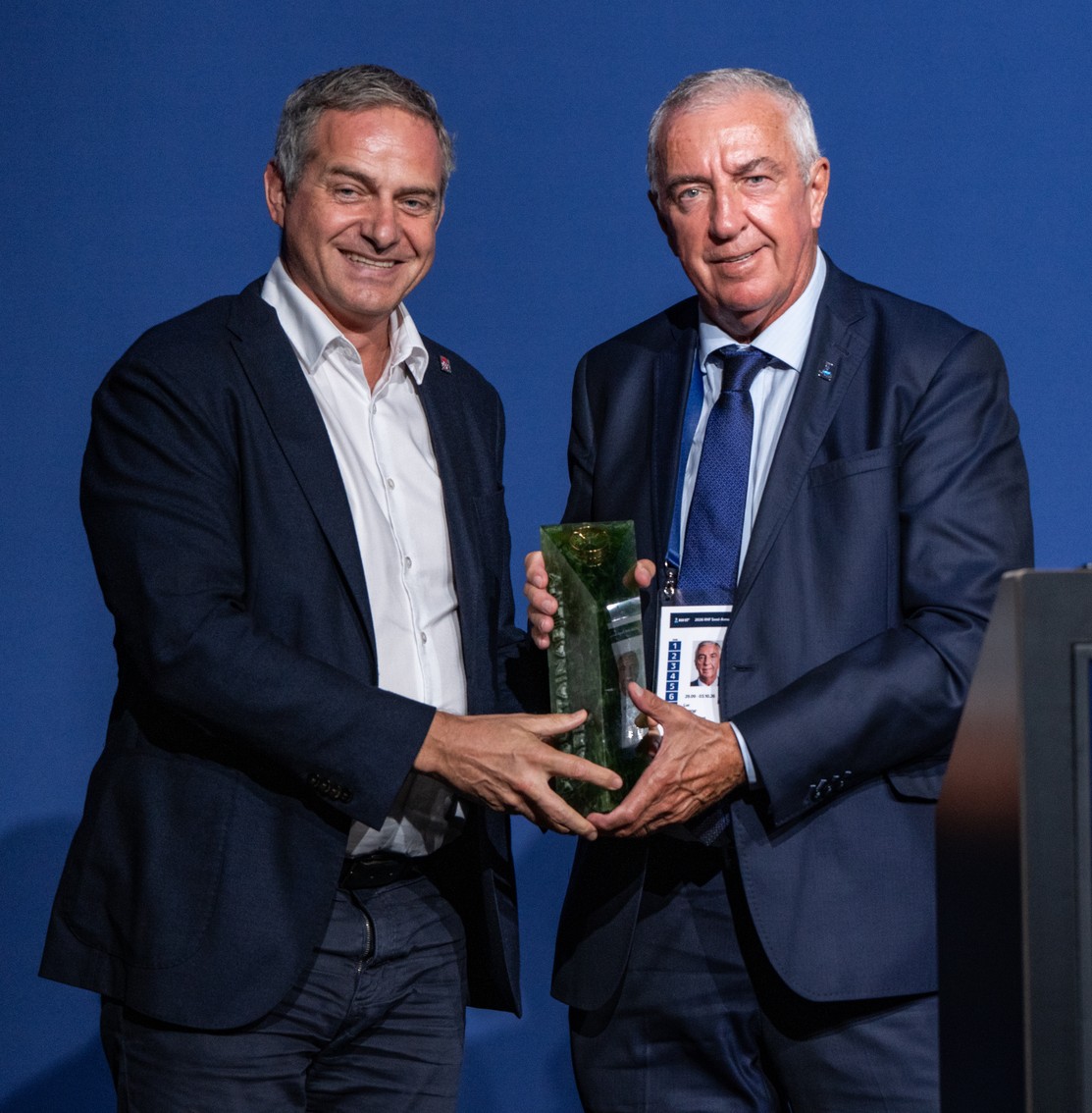
Christian Hofstetter accepted the award on behalf of the Organizing Committee from Beate Grupp, Chairperson of the IIHF Sustainability Committee. France took second place, with Hong Kong, China finishing third.
Introduced in 2019, the IIHF Sustainability Award recognizes initiatives within the international ice hockey community that contribute to a more sustainable future for the sport. It gives Member National Associations an opportunity to share their experiences, gain recognition for their work and inspire others to take action.
The award reflects a broad understanding of sustainability, encompassing environmental protection, social inclusion and the long-term development of ice hockey. By highlighting approaches that can be adapted to different countries, resources and circumstances, the IIHF aims to encourage progress at every level of the game.
This year’s 11 nominees were Belarus, France, Germany, Hong Kong, China, Hungary, Russia, Slovakia, South Africa, Switzerland, the United Kingdom and the United States. Their projects demonstrated how sustainability can influence everything from daily club operations to the delivery of international championships.
Switzerland’s winning entry placed sustainability at the heart of the World Championship’s planning from the outset. With five pillars integrated into the OC from the beginning and helping to guide the work including: promotion of ice hockey, mobility, infrastructure, climate action and technical innovation.
“For us, we focused on five pillars—promotion of ice hockey, mobility, infrastructure, climate action, and technical innovation,” Hofstetter explained. “In the end, the greatest challenge was to create awareness within the OC and with everything we do. For instance, if we build a Fan Zone, we have to think about how to do this in the best way—what materials do we use? How will food and beverage work? The big challenge is to get everyone on board and have them integrate sustainability into their work.”
That commitment translated into measures encouraging public transport, prioritizing permanent infrastructure and extending the use of equipment through rental and resale. Water dispensers, refillable bottles and reusable tableware at the Fribourg venue helped reduce waste. The event also undertook the first carbon footprint calculation in the history of the IIHF World Championship, establishing a basis for measuring progress at future tournaments.
Its sporting legacy included youth-coach and referee development, investment in women’s ice hockey, a new junior women’s league and support for 120 grassroots clubs.
France’s second-place initiative showed how a federation can help clubs make sustained progress together. Launched in 2023, its sustainability label program combines expert support with audits, action plans and continuous improvement. Initially involving 12 top-league clubs, the program is expanding to 28 clubs and the federation, with successful initiatives shared for others to adopt.
Third-placed Hong Kong, China applied an integrated sustainability approach across three IIHF tournaments in March and April 2026. Organizers diverted 7.71 tonnes of food waste from landfill for conversion into biogas and compost, donated tournament furnishings for continued use and provided free tickets to NGOs and people on low incomes through the Inclusive Future program.
Together, the honorees demonstrated the value of addressing local needs while contributing to a shared responsibility for the sport’s future.
“Legacy, for instance, is another critical factor, doing things today that continue into the future,” Grupp said.
Christian Hofstetter accepted the award on behalf of the Organizing Committee from Beate Grupp, Chairperson of the IIHF Sustainability Committee. France took second place, with Hong Kong, China finishing third.
Introduced in 2019, the IIHF Sustainability Award recognizes initiatives within the international ice hockey community that contribute to a more sustainable future for the sport. It gives Member National Associations an opportunity to share their experiences, gain recognition for their work and inspire others to take action.
The award reflects a broad understanding of sustainability, encompassing environmental protection, social inclusion and the long-term development of ice hockey. By highlighting approaches that can be adapted to different countries, resources and circumstances, the IIHF aims to encourage progress at every level of the game.
This year’s 11 nominees were Belarus, France, Germany, Hong Kong, China, Hungary, Russia, Slovakia, South Africa, Switzerland, the United Kingdom and the United States. Their projects demonstrated how sustainability can influence everything from daily club operations to the delivery of international championships.
Switzerland’s winning entry placed sustainability at the heart of the World Championship’s planning from the outset. With five pillars integrated into the OC from the beginning and helping to guide the work including: promotion of ice hockey, mobility, infrastructure, climate action and technical innovation.
“For us, we focused on five pillars—promotion of ice hockey, mobility, infrastructure, climate action, and technical innovation,” Hofstetter explained. “In the end, the greatest challenge was to create awareness within the OC and with everything we do. For instance, if we build a Fan Zone, we have to think about how to do this in the best way—what materials do we use? How will food and beverage work? The big challenge is to get everyone on board and have them integrate sustainability into their work.”
That commitment translated into measures encouraging public transport, prioritizing permanent infrastructure and extending the use of equipment through rental and resale. Water dispensers, refillable bottles and reusable tableware at the Fribourg venue helped reduce waste. The event also undertook the first carbon footprint calculation in the history of the IIHF World Championship, establishing a basis for measuring progress at future tournaments.
Its sporting legacy included youth-coach and referee development, investment in women’s ice hockey, a new junior women’s league and support for 120 grassroots clubs.
France’s second-place initiative showed how a federation can help clubs make sustained progress together. Launched in 2023, its sustainability label program combines expert support with audits, action plans and continuous improvement. Initially involving 12 top-league clubs, the program is expanding to 28 clubs and the federation, with successful initiatives shared for others to adopt.
Third-placed Hong Kong, China applied an integrated sustainability approach across three IIHF tournaments in March and April 2026. Organizers diverted 7.71 tonnes of food waste from landfill for conversion into biogas and compost, donated tournament furnishings for continued use and provided free tickets to NGOs and people on low incomes through the Inclusive Future program.
Together, the honorees demonstrated the value of addressing local needs while contributing to a shared responsibility for the sport’s future.
“Legacy, for instance, is another critical factor, doing things today that continue into the future,” Grupp said.
2026 IIHF Sustainability Award Nominees:
Belarus
France
Germany
Hong Kong
Hungary
Russia
Slovakia
South Africa
Switzerland
UK
USA